
Matt Henninger On Building AI Tools That Support Musicians
Words by Lydia Norton; photos provided by Matt Henninger and AlgoRhythms
The presence of artificial intelligence (AI) is seemingly inescapable. Within seconds, simple text prompts transform into an image or even a song when using generative platforms such as Suno and Udio. Some creatives view AI as a threat. Others, like Moises executive Matt Henninger, see it as something different: a tool musicians can learn from.
“The real core for us is being musician-focused. To help their creative journey, not to replace it,” Henninger says. “It’s to put the musician at the center of a pool of new technologies.”
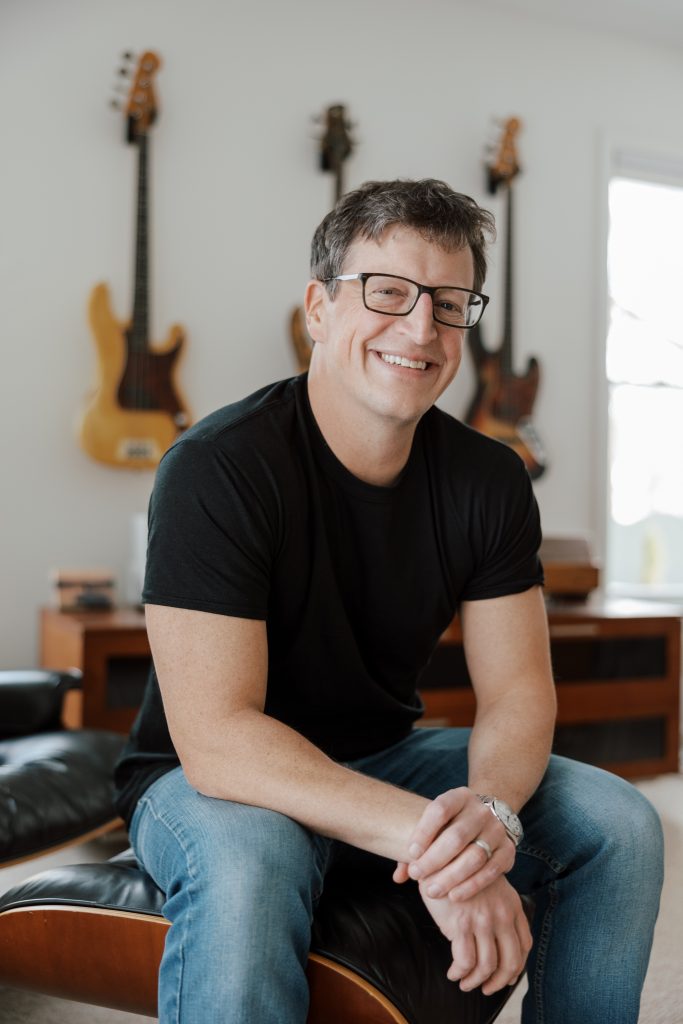
Henninger has about twenty years of experience in digital music and music technology. He earned undergraduate degrees in jazz performance and political science from the University of Michigan. He spent time as a professional bass player, playing nearly 200 nights a year in Detroit. He started at a company called AllMusic (formerly All Music Guide) in Ann Arbor, which was the beginning of factual music metadata. Later, he worked in business development and sales for various music technology services.
Now, Henninger serves as the vice president of business development and strategy at Moises, which started as an app for music practice. If a drummer wants to play along to their favorite song, Moises can remove the drums. It can also isolate instruments, allowing musicians to learn and practice. Today, it has over 70 million users worldwide. The platform now supports multiple instruments, can identify chords in real time, and transcribe lyrics in nearly 100 languages down to the syllable level. Moises expanded its suite of services beyond music practice into music creation.
Henninger stresses that Moises’s use of artificial intelligence is designed to benefit the creator. It has the potential to help break musicians out of writer’s block, assist them in practicing a section of a song, or produce chord charts. When Henninger joined Moises in 2022, the company was starting to scale, and the industry was taking notice. At the same time, generative music platforms like Suno and Udio started to gain traction, leading musicians to think AI meant replacement.
“Just because you can doesn't mean you should, right?” Henninger says. “I think in music in particular, you have to have a very specific lens and a clear mission statement on who you want to be very early.”
Moises decided to only train its AI models on fully-licensed materials. Henninger explained that all the models Moises uses were built in-house, they own the entire data pipeline, and they’ve paid and licensed all the content specifically for the purpose of training it.
“They're expensive decisions,” Henninger says. “They're slow decisions, but we knew that to be in music and build technology with longevity, you have to do these things. Because an artist has to feel like their art is valued by the technology that they're using.”
While Henninger focuses on how technology can support artists, the broader music ecosystem also plays a major role in shaping opportunities for musicians. In the Midwest, that ecosystem is already proving to be a powerful economic force.
While many independent venues and artists operate on thin margins, the music sector remains a powerful economic engine in Indiana. According to the National Independent Venue Association (NIVA) and the Indiana Independent Venue Alliance (IIVA), independent venues, promoters, and festivals in Indiana generated $1 billion in total economic output, contributed $578.9 million directly to state GDP, supported 3,800 jobs, paid $300 million in wages and benefits, and produced $97.4 million in annual state and local tax revenue.
In 2024, fans attending shows at independent venues in Indiana generated $80.3 million at local restaurants, hotels, shopping, transportation, or other entertainment. By comparison, Indiana’s northern neighbor, Michigan, reported significantly higher statistics, generating $2 billion in total economic output, creating a $1 billion contribution to the state's GDP, employing 6,742 workers, and generating $100.3 million in state tax revenue.
Michigan also generated $184.8 million in off-site tourism spending, more than double Indiana’s total.
Henninger says part of Michigan’s music success is in its DNA, citing Motown’s success in marking Detroit as a cultural hub in the music world. Yet, Michigan’s ecosystem is fueled by people around the state.
“Detroit has a self-identity of being gritty and loving the work,” Henninger says. “Especially with everything Detroit’s been through, when you have an art scene that has some of that grittiness in its DNA and this mindset of let’s grind it out, it’s evident in the music.”
Henninger mentioned playing thousands of shows during his career as a musician, and emphasized the pride local musicians have in the music scene and an inherent willingness to practice, learn, and put in the work.
Henninger says, “The Michigan music scene is shockingly supportive of itself, and it’s remarkable. There’s a lot of pride in the practice because that’s part of the grind.”
Perspectives like Henninger’s—shaped by both industry experience and firsthand involvement in regional music scenes—are part of the conversation at the upcoming AlgoRhythms Summit.
Henninger will appear as a panelist at AlgoRhythms, held March 26-28. Through a series of panels, speakers will explore human-centered creativity in music and AI. Henninger is scheduled to speak on the March 28 panel, Business Transformation in the Music AI World. He hopes to explore how different cultures and markets are consuming music, how Moises has grown, and what opportunities are available when technology is democratized. He hopes to educate people on what to look for and how to distinguish between platforms that are tools for artmaking and others that are used like a toy. He doesn’t assume he’s an expert. Like the rest of us, he can’t be sure what’s going to happen next with AI. But what he can do is show people where the technology is going and what the ramifications are.

Henninger says, “I've had the chance to speak at a couple of universities, and what I'm learning is that there's obviously fear around the technology. I enjoy coming in and being a bit of an optimist, telling the audience, ‘Look, if AI can become a tool, it really can benefit you as a musician and as an artist.’”
Ultimately, Henninger hopes AI will help artists harness their creative process. He emphasizes that the key is for technology to meet artists where they are, with tools that can capture the spark when inspiration strikes. He references two scenarios: a master engineer in a studio who fears AI could replace both their role and the art they create, and, conversely, the idea that if applied correctly, AI could help teach a young musician the importance of mastering quickly.
Henninger says, “If you’re in a band, there are probably four phones there, right? How do I make you collaborate more easily? How do I make you take an idea from a rehearsal, keep it, and share it? To me, if you apply AI very specifically to these things, it can be really helpful.”
As AI continues to reshape the music industry, Henninger says Moises sees its role as helping define the difference between creative tools and generative platforms.
“Our goal, even with that tool, is never to create a finished product,” Henninger says.
We want to enable that art, that musician, that creator from a scratch pad to wherever they feel like taking it. Let’s bridge that gap, not try to replace it.”

